
Hydrogen is seen as one of the energy carriers of the future, and for good reasons. With the pressing challenges of climate change and the need to replace fossil fuels, hydrogen offers a promising solution. Hydrogen can be produced from a variety of sources, including renewables such as solar and wind power, and has the potential to provide a clean, sustainable energy supply. Unlike fossil fuels, the use of hydrogen in energy production produces no harmful emissions, making it a key building block for an environmentally friendly future. Hydrogen can also be stored and transported efficiently, making it ideal for the global energy market.
However, leakage monitoring is crucial when using hydrogen. Pure hydrogen cannot burn. However, if around 4% hydrogen is mixed into air at atmospheric pressure, this mixture can be ignited with an ignition source.
Another important aspect is that hydrogen molecules are smaller and lighter than many other gases, which means that they can move through leaks faster and with greater agility.
New Cosmos Electric is a manufacturer of gas detectors in Japan that deals with gas alarm systems for both the home and industrial use.
Features and detection principle of catalytic sensors
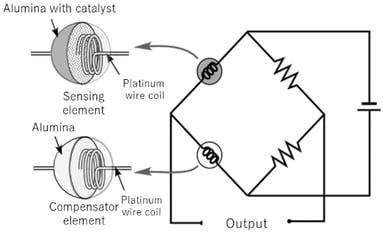
Catalytic sensors convert the heat generated by the combustion of combustible gas (catalytic combustion) on a precious metal catalyst into an electrical signal. As shown in the illustration on the right, the sensor consists of a detector element and a temperature compensator.
The two elements form a Wheatstone bridge circuit and are operated by applying a defined voltage and heating the Pt wire coil to 300 to 500 °C by self-heating. The detector element consists of aluminum oxide coated with a precious metal catalyst (Pt or Pd), which is applied to a 20-30 μm spherical Pt wire coil and sintered.
The temperature compensator consists of aluminum oxide without a precious metal catalyst, which is also sintered onto a Pt wire coil in a spherical shape. This structure allows the temperature to rise only in the sensor element (higher resistance) due to gas combustion in the presence of combustible gas, and the resistance of both elements changes in a similar way to compensate for the ambient temperature.
The temperature change of the element due to gas combustion can be measured with high accuracy even if the temperature changes in a wide range from -40 to 100 °C. The amount of heat ΔH generated by gas combustion at the detector element is proportional to the gas concentration C and the heat of combustion Q, as shown in equation (1), and its value is determined by the combustion efficiency (catalytic capacity) K of the detector element.
⊿H∝ K・C・Q
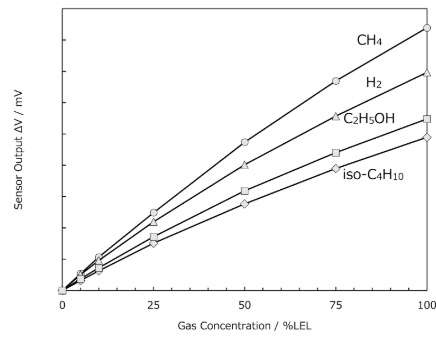
The figure shows the gas sensitivity characteristics of the sensor for flammable gases.
Catalytic hydrogen sensors for industrial applications
Our 'Fuel Cell Electrical Vehicle' (FCEV) compliant FCS-H20 hydrogen (H2) sensor offers maximum safety performance, long sensor life, fast response time and high durability.
Fast-response, long-life H2 sensor FCS-H20
The FCS-H20 is a catalytic sensor that offers a long service life as well as a fast start and response time. It is also characterized by low power consumption, small size, low weight and low cost.
The FCS-H20 maintains its measuring range of 0 to 4 % vol. maintenance-free for more than 15 years, even under extreme conditions such as those found in the automotive sector.
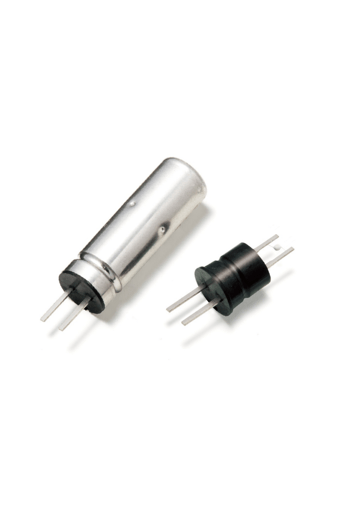
Fast-response, long-life H2 sensor FCS-H20
The FCS-H20 is a catalytic sensor that offers a long service life as well as a fast start and response time. It is also characterized by low power consumption, small size, low weight and low cost. The FCS-H20 maintains its measuring range of 0 to 4 % vol. maintenance-free for more than 15 years, even under extreme conditions such as those found in the automotive sector.
Resistant to siloxane poisoning
High resistance to siloxane poisoning is particularly important in automotive applications, as siloxane vapor can impair the sensitivity of the sensor. A high dispersion of Pd/Pt nanoparticles on aluminum oxide (Al2O3) and the addition of an additional sintering aid achieve strong sintering properties and ensure the functionality required for the sensor element.
Some application examples for the use of hydrogen:
- Mobility
Hydrogen plays a pivotal role in mobility by enabling clean and sustainable energy solutions. One key application is its use in power-generating devices, such as fuel cells, which produce electricity through the chemical reaction of hydrogen with oxygen. This technology is at the core of hydrogen-powered vehicles, offering a zero-emission alternative to traditional fossil fuel engines.
A prime example of this innovation can be seen in Toyota Motor Corporation ’s latest hydrogen-powered vehicle, the Toyota MIRAI.
This cutting-edge vehicle utilizes New Cosmos Electric's FCS-H20 hydrogen sensor, which meets Toyota's rigorous performance and quality standards. Furthermore, the FCS-H20 complies with GTR-13 (Global Technical Regulation No. 13), the international safety standard for hydrogen and fuel cell vehicles.

New Cosmos Electric Hydrogen Detector for FCV
The FCS-H20 sensor can be acquired under the product designation CSD-04/05.
Read more
- Hydrogen filling stations
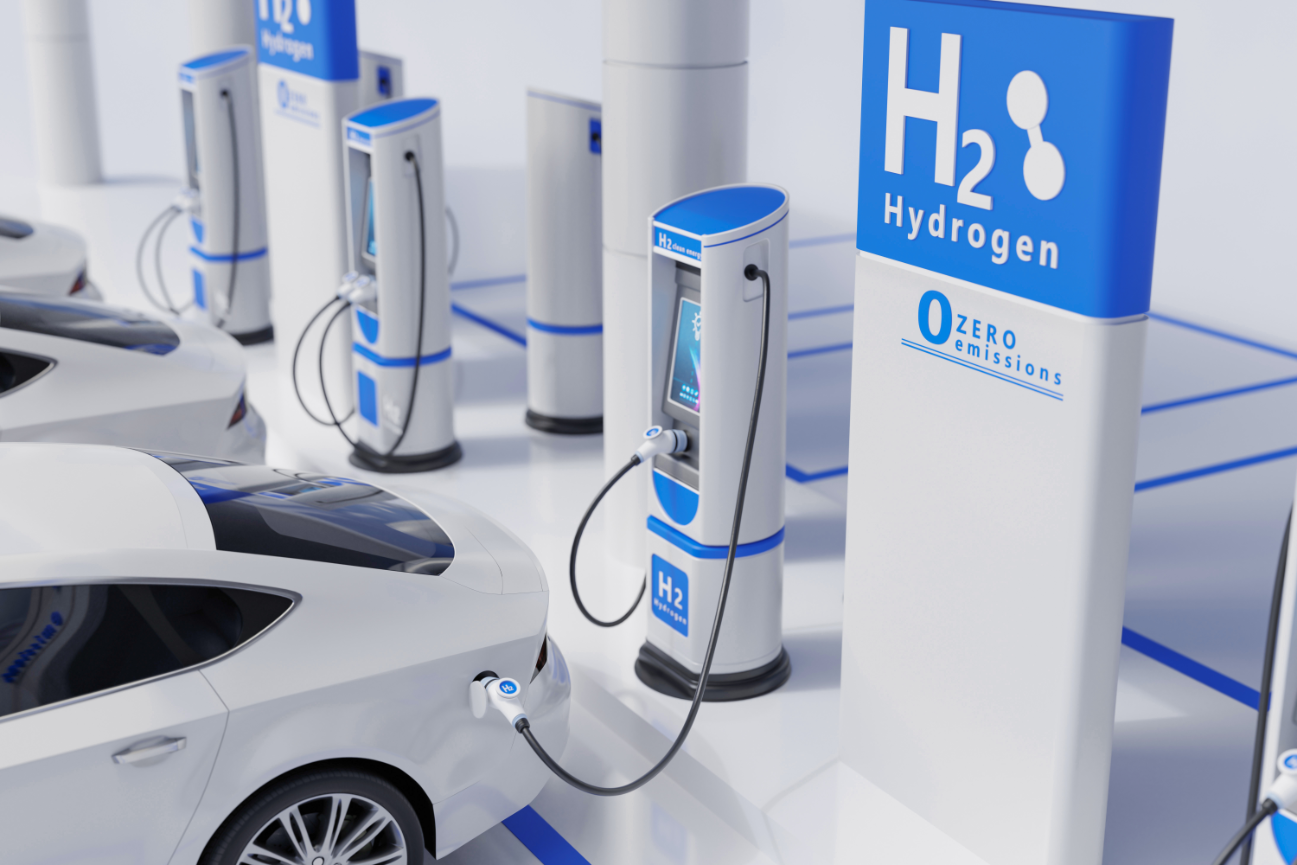
Hydrogen filling stations serve as critical infrastructure for refueling vehicles powered by fuel cells or hydrogen engines. At these stations, hydrogen is produced and purified before being compressed using high-pressure compressors. The compressed hydrogen is then stored in specialized tanks under elevated pressure, ensuring a reliable and efficient refueling process while adhering to stringent safety standards.
Given the unique properties of hydrogen—such as its low atomic weight and ability to diffuse easily—safety measures are paramount. To mitigate the risks associated with hydrogen leaks, New Cosmos Electric provides cutting-edge detection solutions. In fact, 80% of hydrogen filling stations in Japan are equipped with New Cosmos Electric’s advanced gas detection systems, a testament to the company’s industry leadership and commitment to safety.
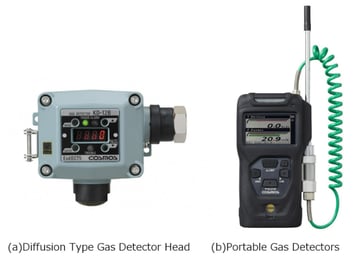
For instance, the KD-12 diffusion gas detector head (Figure (a)), designed based on experimental hydrogen diffusion studies and computational fluid dynamics (CFD) simulations, ensures reliable hydrogen detection. Housed in explosion-proof casings, these sensors are optimized for the specific challenges of hydrogen monitoring.
In addition to fixed detectors, portable gas detectors (Figure (b)) equipped with concentration displays are utilized for routine maintenance and inspection. These devices play a critical role in identifying potential leaks at valves, pipe connections, and other critical points within hydrogen refueling stations, ensuring the highest levels of safety and operational reliability.
By combining advanced sensor technology with a commitment to safety, New Cosmos Electric not only supports the growing adoption of hydrogen as a clean energy solution but also ensures the safe and efficient operation of hydrogen infrastructure worldwide.